The 5 Hardest AP® Psychology Problems
Mr Carter’s Guide
Hi everyone! After years of teaching AP® Psychology, I’ve noticed that the same five concepts trip up students year after year. These aren’t just difficult topics – they’re the ones that separate the 3s from the 5s on exam day. I’ve distilled everything I’ve learned about teaching these tricky concepts into this guide. Let’s turn your biggest challenges into your strongest skills.
– Mr. Carter
#5. How do I tell the difference between Classical and Operant Conditioning?
You’re sitting in your AP® Psych class, and your teacher throws out a scenario: “Sarah gets anxious every time she hears the school bell because it reminds her of pop quizzes. Is this classical or operant conditioning?” Half the class says classical, half says operant, and you’re sitting there wondering why this concept feels impossible to nail down.
Here’s the thing – most students get confused because they’re trying to memorize definitions instead of understanding what’s actually happening. Let me give you a simple way to never get this wrong again.
- Pavlov = Classical (automatic responses)
- Automatic responses happen BEFORE behavior
- Consequences = Operant (learned behaviors)
- Earned consequences happen AFTER behavior
Here’s what this actually means: Classical conditioning is when your body automatically reacts to something without you choosing to react. Think about walking into a dentist’s office and automatically feeling nervous when you hear the drill sound. You didn’t decide to feel nervous – it just happened because your brain connected that sound with pain from past experiences.
Operant conditioning is when you learn to do (or not do) certain behaviors because you know what will happen afterward. Like studying extra hard because you know you’ll get a good grade, or avoiding certain foods because they made you sick before.
Classical conditioning involves involuntary responses (salivating, fear responses, feeling happy when you hear your favorite song), while operant conditioning involves voluntary behaviors (studying, driving, talking, choosing what to eat).
If the question mentions reflexes, emotions, or automatic responses → Classical. If it mentions choices, decisions, or learned skills → Operant. Use PACE to double-check yourself!
#4. What’s the difference between Positive and Negative Reinforcement?
I guarantee you’ve been in this situation: You’re reviewing for the AP® exam with friends, and someone says “Wait, so negative reinforcement is punishment, right?” Then someone else argues it’s not, and suddenly everyone’s confused about what “positive” and “negative” even mean in psychology.
The confusion happens because in everyday life, “positive” means good and “negative” means bad. But psychology doesn’t work that way. In psychology, these terms work like math.
Think like you’re doing math: Positive means you ADD something (+). Negative means you TAKE AWAY something (-). That’s it. It has nothing to do with whether something is good or bad.
Here’s how this works in real life:
Imagine your little brother keeps interrupting you while you’re studying. Here are the four things your parents could do:
Positive Reinforcement (ADD something good)
Every time he doesn’t interrupt for an hour, he gets screen time. You’re adding something he wants, so he’ll interrupt less.
Negative Reinforcement (REMOVE something bad)
Your parents stop nagging him about cleaning his room as long as he doesn’t interrupt you. You’re taking away something annoying, so he’ll interrupt less.
Positive Punishment (ADD something bad)
Every time he interrupts, he has to do extra chores. You’re adding something he doesn’t want, so he’ll interrupt less.
Negative Punishment (REMOVE something good)
Every time he interrupts, he loses 30 minutes of video game time. You’re taking away something he enjoys, so he’ll interrupt less.
Reinforcement = behavior increases, Punishment = behavior decreases. The positive/negative just tells you whether you’re adding or subtracting something to make that happen.
#3. How are Validity and Reliability different in research?
Every AP® Psych student has been there – you’re reading a research study for an FRQ, and the question asks you to evaluate its validity and reliability. You know these are important concepts, but in the moment, they feel like the same thing. Your brain starts mixing them up, and you end up writing something that doesn’t make sense.
The reason this happens is that both concepts are about whether research is “good,” but they measure completely different aspects of “good.”
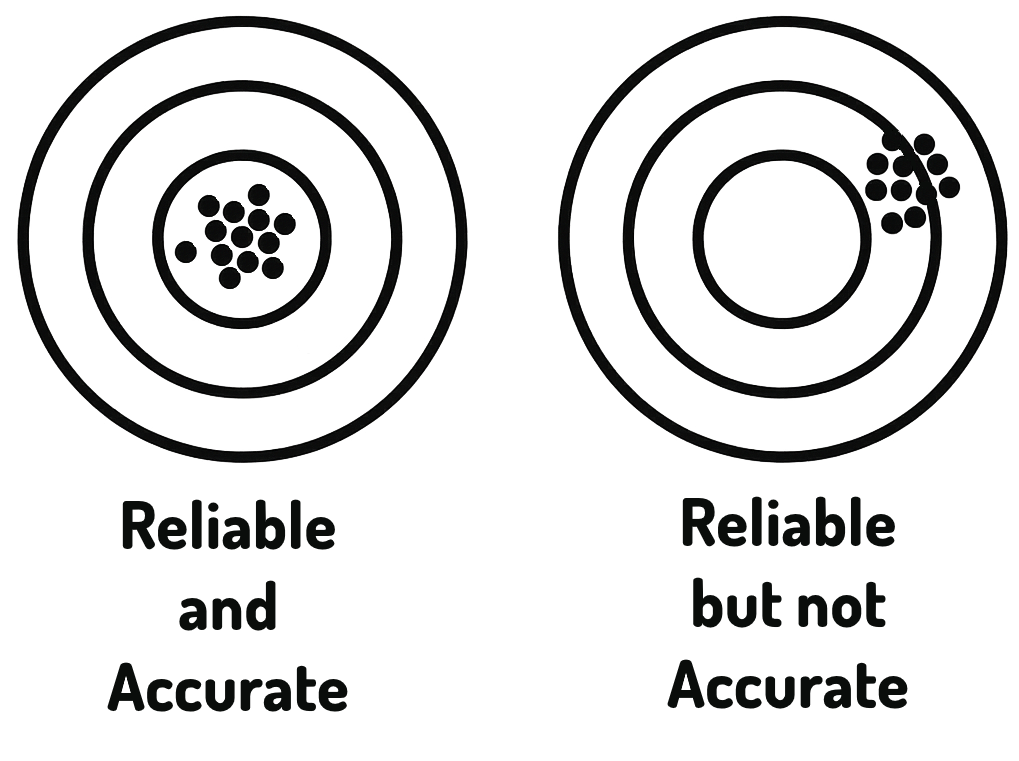
Picture yourself throwing darts at a dartboard. This analogy will make it crystal clear:
RELIABILITY = Consistency. If you throw 10 darts and they all land in the exact same spot, you’re reliable. It doesn’t matter if you hit the bullseye or not – you’re consistent.
VALIDITY = Accuracy. If your darts actually hit the bullseye (the target you’re aiming for), you’re valid. Even if they’re scattered all around the bullseye, as long as they’re generally in the right area, you’re measuring what you intended to measure.
In psychology research, this means:
- Reliability: If you repeat the exact same study, you get similar results every time
- Validity: Your study actually measures what you claim it’s measuring
Let’s say you want to measure intelligence, but your test only asks math questions. Your test might be super reliable (everyone gets consistent scores when they retake it), but it’s not valid because intelligence involves way more than just math. You’re reliably measuring math ability, not intelligence.
Types you need to know:
• Internal Validity: Are you sure your independent variable actually caused the changes you observed?
• External Validity: Can you apply these results to other people and situations?
• Test-Retest Reliability: Do people get similar scores when they take the test again?
#2. What are all these different types of memory and how do they work?
Memory questions on the AP® exam can feel overwhelming because there are so many different types and models to keep track of. You might understand each type individually, but when you have to explain how they all work together, or identify which type is being used in a specific scenario, everything gets jumbled up.
The secret is to master the basic framework first, then everything else clicks into place.
Multi-Store Model: Think of memory like a factory assembly line
Step 1: Sensory Memory – Lasts about half a second to 3 seconds max. It’s like a snapshot of everything around you right now. Most of it disappears immediately because your brain can’t handle processing everything at once.
Step 2: Short-Term Memory – Lasts about 15-30 seconds and can hold about 7 pieces of information (like a phone number). If you don’t do something with this information, it disappears forever.
Step 3: Long-Term Memory – This is your permanent storage. It lasts forever and can hold unlimited information.
But here’s where it gets tricky – Long-Term Memory has different types:
Explicit Memory (you’re aware of it)
Episodic: Your personal experiences, like remembering your 10th birthday party
Semantic: Facts and general knowledge, like knowing that Paris is in France
Implicit Memory (you’re not aware of it)
Procedural: Skills you do automatically, like riding a bike or typing
Priming: When something unconsciously influences you, like seeing the word “yellow” makes you more likely to say “banana” later
Think of explicit as “express” – you can express these memories in words. Implicit memories are harder to put into words.
#1. How do I remember what each neurotransmitter does?
This might be the most frustrating part of AP® Psychology. You’re staring at a list of neurotransmitters with their functions and associated disorders, trying to memorize what feels like random information. Dopamine, serotonin, acetylcholine, GABA – they all start to blur together, and you can never remember which one does what.
The good news? You don’t need to memorize random facts. You need memorable stories that connect each neurotransmitter to what it actually does in your brain.
DOPAMINE – The “Drive” Chemical
Dopamine = Drive and Desire
This is your motivation chemical. It’s what makes you want things and feel good when you get them.
Too little: Parkinson’s disease (can’t move well) and depression (no motivation)
Too much: Schizophrenia (overactive reward system leads to delusions)
SEROTONIN – The “Serenity” Chemical
Serotonin = Serenity and Sleep
This is your happiness and calm chemical. It also controls sleep and appetite.
Too little: Depression and anxiety
Fun fact: Most of your serotonin is actually in your gut, not your brain!
ACETYLCHOLINE – The “Action” Chemical
Acetylcholine = Action and Attention
This chemical makes your muscles move and helps you pay attention and form memories.
Too little: Alzheimer’s disease (memory problems) and muscle weakness
Key fact: It’s the main chemical that makes your muscles contract
GABA – The “Chill Out” Chemical
Get A Break Already!
This is your brain’s brake pedal. It calms everything down and reduces anxiety.
Too little: Anxiety disorders and seizures
Fun fact: Alcohol increases GABA activity, which is why people feel relaxed when drinking
Quick Review: Don’t Make These Common Mistakes
- Confusing positive/negative with good/bad (it means add/subtract)
- Thinking classical conditioning applies to all learning (only for automatic responses!)
- Mixing up reliability and validity (consistency vs. accuracy)
- Forgetting the memory processing sequence (sensory → short-term → long-term)
- Trying to memorize neurotransmitters without associations (use the memory tricks!)
Final Exam Strategy Tips
For Multiple Choice Questions
• Read the question twice before looking at answers
• Look for key words that signal specific concepts
• Use the memory tricks and acronyms from this guide
• Trust your first instinct unless you have a solid reason to change
For Free Response Questions
• Define every psychology term you use clearly
• Use specific, detailed examples that connect to the concept
• Show your thinking process step-by-step
• Make sure you address all parts of the question
Time Management
• Multiple Choice: About 1 minute per question
• Free Response: Plan for 5 minutes, write for 20 minutes per question
The Night Before
• Review this guide one more time
• Get a good night’s sleep
• Don’t try to learn new concepts – just review what you already know